
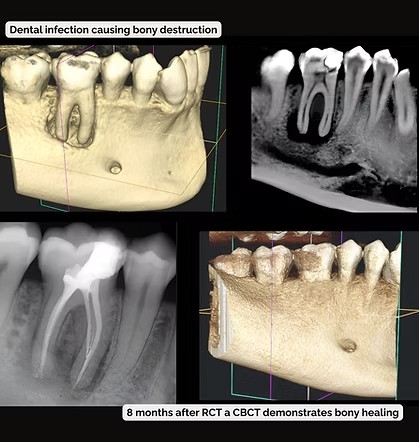
Root canal treatment saves teeth. The restoration placed afterwards determines whether those teeth stay saved. This is one of the most under-discussed aspects of endodontic outcomes in general practice — and one of the most significant predictors of long-term success.
The Evidence Is Unambiguous
Studies consistently show that the restoration placed after root canal treatment has a greater influence on long-term tooth survival than the quality of the root canal treatment itself. A technically excellent root canal in a tooth with an inadequate or poorly timed restoration has a significantly worse prognosis than a reasonable root canal in a well-restored tooth.
This is counterintuitive to patients, who assume the hard part is the root canal. It surprises some GDPs too. But the biology is straightforward: a root-filled tooth with a temporary restoration or an inadequate coronal seal allows bacterial ingress into the canal system. The root canal is not a sterile space preserved in perpetuity — it's a sealed system that fails when the seal is breached.
Timing: Why Temporisation Has a Limit
A temporary restoration immediately post-endodontic treatment is appropriate. An extended period in temporisation is not.
The evidence suggests that temporary restorations begin to leak in as little as three months. After six months, the risk of coronal contamination is substantial. A root canal completed in January that still has a temporary dressing in October has likely been recontaminated regardless of how well the endo was done.
The restoration should be placed as promptly as clinical circumstances allow. Where a crown is the planned restoration, that means impressions or scans at the earliest suitable appointment — typically within four to six weeks of completing treatment — not as an open-ended future plan.
Cuspal Coverage: Which Teeth and Why
The question of whether to place a crown versus an onlay versus a direct composite restoration is frequently oversimplified. The evidence-based answer depends on which tooth and how much tooth structure remains.
Posterior teeth — particularly upper and lower molars and premolars — that have undergone root canal treatment are at significantly higher risk of vertical root fracture than vital teeth. The loss of the pulp removes the tooth's proprioceptive sensitivity, meaning patients cannot sense excessive occlusal load on that tooth. The dentine becomes more brittle over time as the pulp-derived hydration is lost.
Cuspal coverage — a crown or onlay that protects the remaining cusps from lateral fracture forces — is indicated for posterior root-treated teeth as a matter of clinical standard, not patient preference. The tooth that fractures vertically three years post-RCT in the absence of cuspal coverage is the predictable outcome of an unprotected root-filled molar.
Anterior teeth are a different case. An upper central incisor with adequate remaining tooth structure and a minimally invasive access cavity can be restored with a composite and monitored long-term. Cuspal coverage is not indicated. The clinical decision must be made on the tooth's individual situation, not applied universally.
Ferrule Effect
This is worth understanding precisely. The ferrule is the band of sound tooth structure above the crown margin that the crown engages circumferentially. Without adequate ferrule — typically defined as at least two millimetres of sound dentine above the level of the crown margin — the crown-tooth complex is significantly weaker and more prone to fracture under load.
A tooth with insufficient ferrule that receives a post and crown is not a well-restored tooth. It is a tooth where failure is being postponed, not prevented.
The presence of a crown gives the patient a false sense of security, and the subsequent fracture — often at the gum line, making salvage impossible — is a worse outcome than the one a frank conversation about extraction beforehand would have produced.
If ferrule is inadequate, the options are crown lengthening to expose more tooth structure, or a frank discussion about extraction and replacement. Neither is the wrong answer. Placing a crown without adequate ferrule is.
The Referral Back
When I return a patient to you after endodontic treatment, the report will specify the recommended restoration. If I have concerns about ferrule, tooth structure, or restorability, I'll raise them explicitly — ideally before I undertake treatment, so the restorative plan is agreed upfront.
The post-endodontic restoration is part of the treatment, not an afterthought. The conversation about it should happen before the root canal begins.