

CBCT changes my treatment plan more often than it confirms it. That's why it's worth doing.
The terminology is used interchangeably in general practice, and it shouldn't be. Retreatment and re-root canal describe overlapping but distinct clinical situations, and conflating them leads to muddled treatment planning — and occasionally to the wrong decision entirely. Here's how I think about it.
The Terminology Problem
Root canal retreatment, strictly defined, means the removal of existing root filling material, reinstrumentation of the canal system, and obturation — undertaken because the original treatment has failed or is inadequate.
Re-root canal often means the same thing colloquially, but is sometimes used to describe re-treatment of a previously instrumented but unobturated tooth, or a tooth where previous treatment was incomplete rather than failed. The clinical distinction matters because the difficulty, prognosis, and decision criteria are different in each case.
For clarity: when I refer to retreatment in this post, I mean the removal and replacement of an existing root filling. When I refer to re-treatment of an incompletely treated tooth, I'll say so explicitly.
When I Retreat
The indication for retreatment is persistent or recurrent periapical pathology in a tooth with existing root canal treatment. The question is not whether the original treatment looks adequate on a radiograph — it is whether the tooth is symptomatic, whether periapical pathology is present or progressing, and whether retreatment offers a meaningful improvement in prognosis.
A tooth with a short or inadequately dense fill, periapical radiolucency, and symptoms is a straightforward retreatment case provided the tooth is restorable. I retreat it. A tooth with what appears radiographically to be an adequate fill, no periapical pathology, and no symptoms — but which the patient or referring dentist is uneasy about ahead of a crown or post crown — is a different conversation. In that situation I want a cone beam CT before I commit to anything. The radiograph is not the full picture.
When I Don't Retreat
Two broad categories make me pause before retreating. When the prognosis is unlikely to improve. If the original failure is caused by something retreatment can't address — an untreatable anatomy, a through-and-through perforation, significant external root resorption, a root fracture — retreatment is an intervention without a realistic endpoint.
I'd rather have that conversation early than after an attempted retreat. When extraction and replacement is the better long-term option. A heavily compromised tooth with an uncertain restorative future, existing periodontal attachment loss, and a history of multiple interventions deserves an honest reassessment.
Sometimes the question isn't 'can we retreat this' but 'should we.' The implant conversation isn't a failure. It's a different treatment pathway.
The CBCT Question
I use cone beam CT selectively — not routinely, but earlier than most GDPs would refer for it. The cases where I want it before retreatment: radiographic appearance doesn't match the clinical presentation; suspected perforation or root fracture; calcified canals with previous instrumentation history; post-retained teeth where I need to understand root morphology before making any decision; persistent apical pathology after a radiographically adequate fill.
CBCT changes my treatment plan more often than it confirms it. That's why it's worth doing.
Separated Instruments in a Previous Fill
This comes up regularly in retreatment cases. A fragment visible on the pre-op radiograph changes the complexity significantly — but it doesn't automatically change the decision. The questions I ask: Where is it? Is it at the apex, in the mid-root, or coronal? Is the canal patent beyond it? Is there periapical pathology? Is bypassing it clinically feasible?
A separated instrument in the apical third of a curved canal, in a tooth with no periapical pathology and no symptoms, does not necessarily need to be removed. Managing around it — bypassing, leaving in situ, sealing the canal — is a legitimate option in the right case. Attempting retrieval in a thin, curved root to remove a fragment that isn't causing a problem is a decision that needs careful justification.
A Real Case: Crown, Post, and a Failing Fill
Here's what a straightforward-on-paper retreatment actually looks like once you're in the tooth. Cast post, existing crown, and a fill that no longer held up to scrutiny.
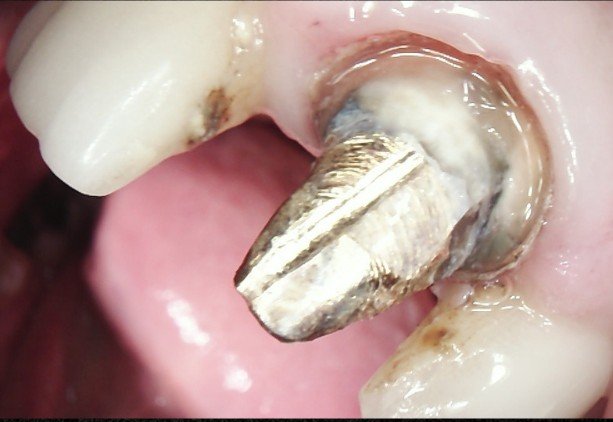
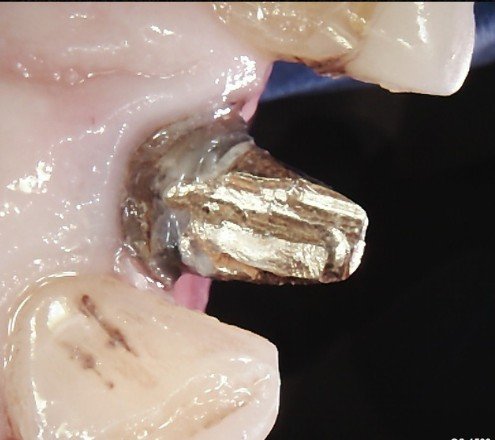
This particular post took roughly forty-five minutes to remove with an endodontic ultrasonic tip. That's not unusual, and it's worth setting that expectation with the patient before you start, not after you're forty minutes in.
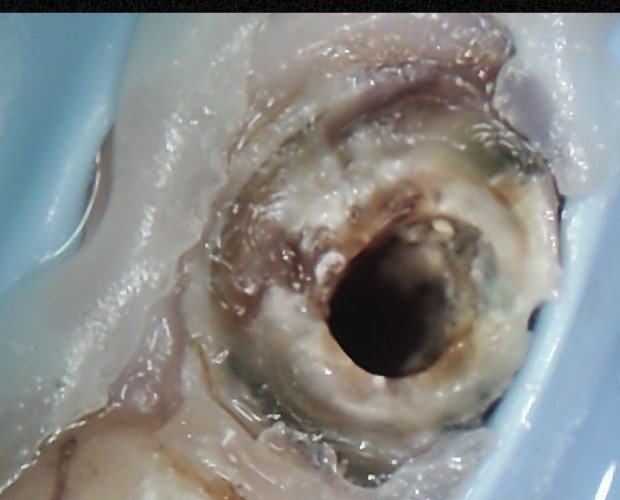
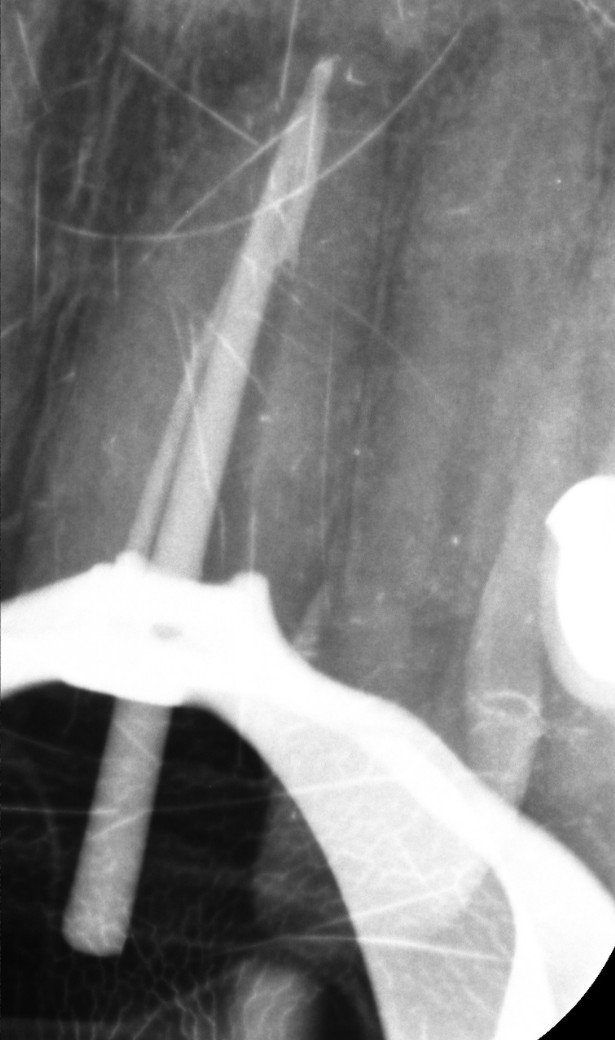
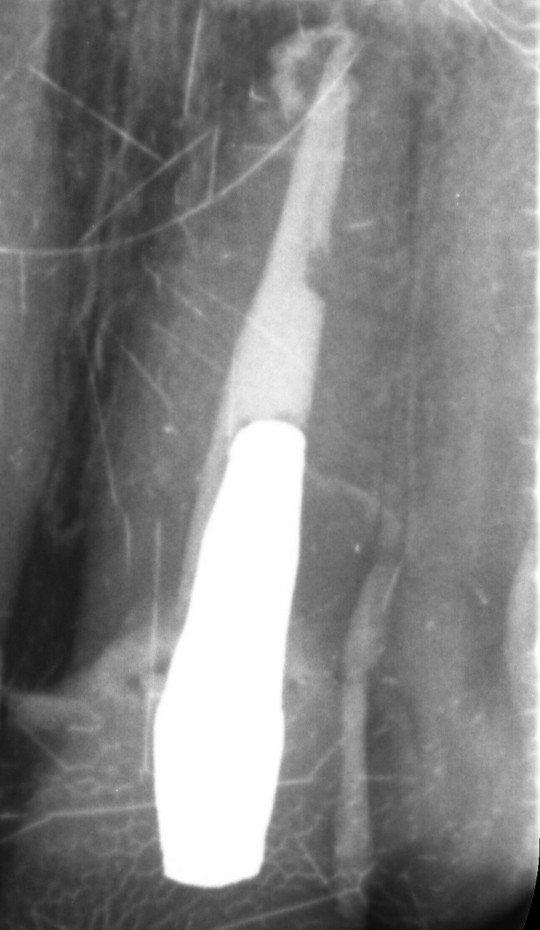
That last line is the point of writing any of this up. Every retreatment case is a chance to sharpen the next one — including the ones that go well.
What I Tell the Referring Dentist
When a case comes to me for retreatment assessment, I give a written report back regardless of whether I proceed. If I decide not to retreat, I explain why and what the alternatives are. If I retreat, you get post-treatment radiographs and a clinical summary.
If you're unsure whether a case warrants retreatment or a different pathway, refer it for assessment before committing to a plan. A conversation costs nothing. An extraction after a failed retreatment costs the patient significantly more.